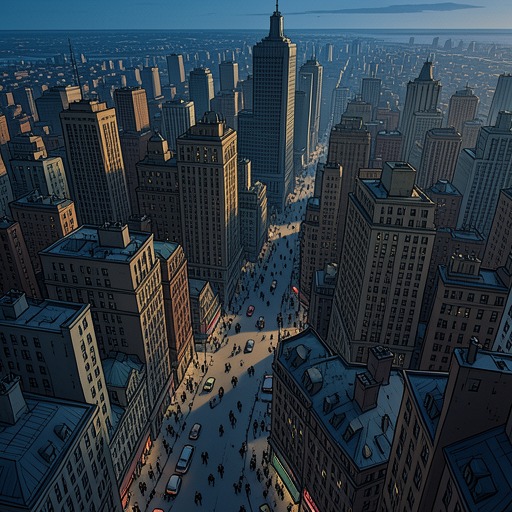
Upper West Side
American PsychoUpper West Side functions as one of the central geographical frames of Patrick Bateman's world: a polished district of expensive apartments, restaurants, private fitness, and professional routine that continually opens onto poverty, exclusion, and violence. It is not merely a home address or backdrop. As Bateman moves through it, the neighborhood becomes a route between Wall Street privilege and the city's marginal spaces, revealing how proximity does not produce social recognition or moral connection.
Setting and Social Position
Upper West Side first appears as a destination associated with the affluent social circuit. After Timothy Price's restless cab ride away from Wall Street, the cab reaches the neighborhood, where Price directs the driver to stop near Eighty-first Street and Riverside because the street does not run in the expected direction. The interruption is characteristic of the district's presentation: it is a recognizable residential zone, but one encountered through traffic, directional errors, advertisements, and the movement of people whose social worlds barely meet.
The neighborhood is also tied to Patrick Bateman's apartment and to the carefully managed routine that sustains his public identity. His membership at Xclusive, a private health club four blocks from his Upper West Side apartment, costs five thousand dollars annually. The club has been remodeled three times in two years and offers Nautilus, Universal, and Keiser weight machines, extensive free weights, tennis and racquetball courts, aerobics studios, swimming pools, Lifecycles, a Gravitron, rowing and treadmill equipment, cardiovascular evaluations, personalized programs, massage, sauna and steam rooms, a sun deck, tanning booths, and a cafe with a juice bar. Its scale turns bodily maintenance into an institutional service and makes the neighborhood the base for Bateman's disciplined, conspicuously expensive appearance.
Domestic and Commercial Performance
Upper West Side connects Bateman's private life to the rituals of elite consumption. In the neighborhood, social contact is organized through reservations, clothing, drinks, transportation, and carefully observed manners. At Courtney Lawrence's brownstone, Bateman and Timothy Price arrive in Armani overcoats; Bateman hands his black wool Giorgio Armani coat to Courtney, who air-kisses him and then repeats the gesture with Price while a Talking Heads CD plays in the living room. The scene presents intimacy as choreography, with clothes, music, and greeting rituals functioning as visible proof of belonging.
The same system extends into restaurants and offices. At Pastels, a bill totaling $475 is divided among the group, while Bateman places the charge on his American Express Platinum Card and collects the others' cash, mostly fresh fifty-dollar bills. Outside, a homeless man asks first for change and then, more hopefully, for food, but the diners' attention remains fixed on his appearance and on the possibility of turning his poverty into a joke. Upper West Side thus contains both the transaction that displays wealth and the street-level deprivation that the transaction helps render invisible.
Bateman's professional routine reinforces this division. At the office, Frederick Dibble discusses gossip and an expensive Italian-Thai restaurant on the Upper East Side while Bateman writes the restaurant's name in his address book. Jean, his devoted secretary, brings Perrier with a wedge of lime and the Ransom file to his office, and Bateman responds by noticing her expensive clothing and instructing her not to wear that outfit again. The neighborhood's cultivated surface is therefore maintained through a chain of subordinate labor, scheduling, service, and correction rather than through private self-sufficiency.
Streets, Exclusion, and Violence
The Upper West Side's controlled interiors repeatedly give way to streets where social boundaries become more visible. Bateman can reject a beggar near Central Park West, take three hundred dollars from an automated teller, and continue walking while preserving the composure associated with his class. He considers opening his briefcase to retrieve a knife or gun, but decides that the woman is too easy a target to be satisfying. The episode links the district's consumer infrastructure to the narrator's predatory imagination: money, weapons, and movement through the city coexist without producing a stable hierarchy of importance.
The neighborhood also contains the men's-room confrontation in which Bateman approaches Luis Carruthers while Luis is urinating in a stall. Bateman has been imagining whether Luis's death would free Courtney from another relationship and whether violence could improve his own position. Wearing leather gloves, he moves behind Luis and places his hands around Luis's neck. In this setting, the polished social rivalry of the restaurant is translated into direct physical threat, demonstrating how the neighborhood's rituals of status can shade into possession and annihilation.
At the same time, Upper West Side is a place where targets may be selected, rejected, or displaced according to Bateman's fluctuating impulses. A black woman begging near an abandoned restaurant is dismissed as too easy a target; a street performer at Columbus Circle is judged insufficiently worthy of his wrath; and the surrounding streets become a search space in which the narrator evaluates bodies, visibility, and vulnerability. The district's apparent order does not prevent violence. It supplies the routes, shelters, thresholds, and anonymous encounters through which violence can be imagined or enacted.
Central Park and the Urban Periphery
Central Park and its zoo intensify the contrast between Upper West Side privilege and exposed vulnerability. At the Central Park Zoo, surrounded by Fifth Avenue buildings, Trump Plaza, and the AT&T building, Bateman finds a landscape that appears emptied of life even while it is crowded with animals, visitors, workers, and children. He insults a black custodian and uses a knife to force the man back; he throws coins into the seals' tank despite a warning that swallowed coins can cause ulcers, infections, and death; and the spectators' enjoyment of the animals becomes, in his account, more offensive than the animals themselves.
The zoo episode shows how the neighborhood's institutions organize looking. Plaques instruct visitors, crowds gather around displays, and animals are made available for public observation, yet Bateman turns the scene into an occasion for aggression. His attention moves from the custodian to the animals, from the audience to a mother breastfeeding her baby, and finally toward a child. The apparently civic space of recreation becomes an extension of the same system that governs restaurants, offices, and clubs: bodies are arranged for inspection, and Bateman treats that arrangement as an invitation to control.
Upper West Side also borders scenes of homelessness that make its affluence materially unstable. On Fifth Avenue, near the children's zoo and close to the place where Bateman says he murdered the McCaffrey boy, the city is described through decay, bodies, traffic, pigeons, burning chestnuts, and carbon monoxide. In front of Trump Tower, Bateman sees a Vietnam veteran whose scarred face and sign identify him as blinded and hungry. The contrast between the gleaming tower and the beggar's exposed body is not accidental scenery: it is the neighborhood's social geography compressed into one view, with monumental wealth towering over people whose need is made publicly visible but politically unaddressed.
Narrative Significance
Upper West Side is significant because it collapses the distance between privileged consumption and urban abandonment. Bateman's apartment, Xclusive, restaurants, offices, parks, zoo, automated teller machines, and abandoned storefronts form a continuous circuit rather than separate worlds. He can move from Perrier and private training to a street beggar, from social air-kissing to strangulation, and from the controlled display of clothing to the exposed bodies of homeless people and animals.
The location also deepens the novel's uncertainty between social reality and Bateman's distorted narration. Upper West Side is described with exact urban markers, consumer details, and recognizable institutions, yet the same precise surface accommodates episodes of extreme brutality and perceptual instability. Near the end, after a night of shootings elsewhere in Manhattan, Bateman reaches his new office, signs in with the night watchman, and leaves a confession on Harold Carnes's answering machine while police and a SWAT team gather across the city. The neighborhood and its surrounding routes have offered him anonymity, but not resolution. Upper West Side remains the place where the appearance of a functioning social order continues to survive beside the evidence of its violence.